October 18, 2026
Selfie Attendance System: How It Works & Beats Biometric Tech
Introduction: From Fingerprint Scanners to Smartphone Selfies
For decades, businesses relied on physical biometric terminals—fingerprint scanners, iris readers, or hand‑geometry devices—to lock down attendance data. While effective, those machines demand a fixed location, regular maintenance, and a touch‑based interaction that became a liability during the COVID‑19 pandemic. In response, a new wave of selfie attendance systems has emerged, leveraging the cameras already embedded in employees’ smartphones.
At its core, a selfie attendance system captures a live facial image, verifies it against a stored facial template, and augments the record with GPS coordinates and a timestamp. The result is a fully contactless, location‑aware proof of presence that can be rolled out across a single office or a geographically dispersed field team with a single software deployment.
In the sections that follow we will unpack the underlying technology, compare it side‑by‑side with traditional biometric machines, and illustrate why many forward‑thinking organisations are making the switch today.
How a Selfie Attendance System Works
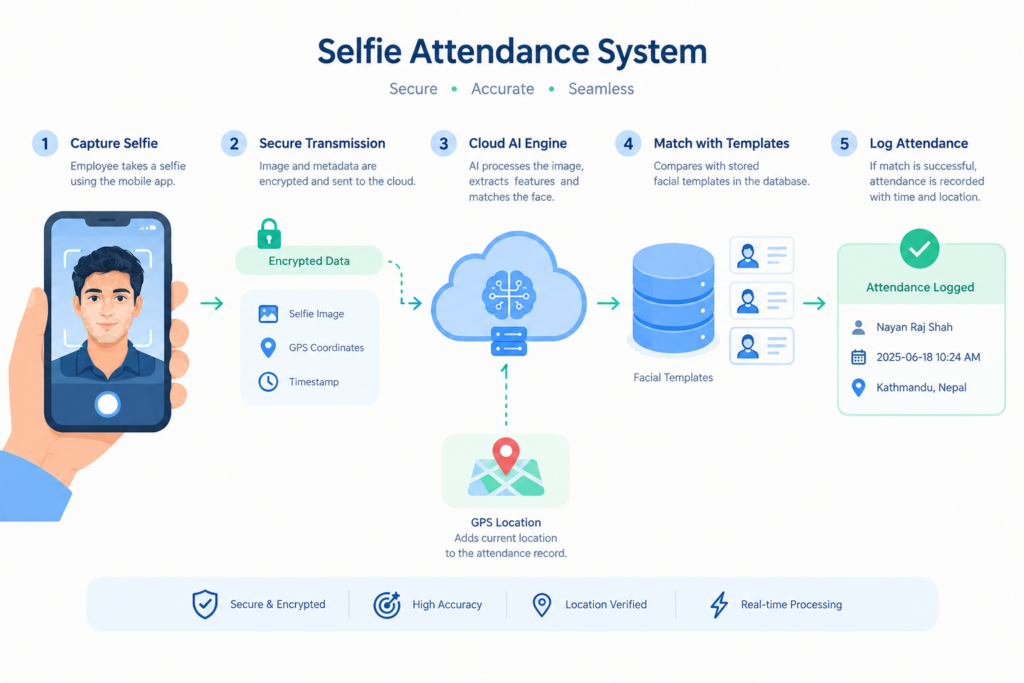
Although the user experience feels as simple as “take a selfie and press submit,” the backend involves several sophisticated steps:
- Live Capture & Liveness Detection – The mobile app accesses the device’s camera and prompts the employee to align their face within a frame. AI‑driven liveness checks (eye blinking, head movement, depth analysis) ensure the image isn’t a static photo or video replay.
- Pre‑processing – The captured image is converted to a normalized format: grayscale conversion, noise reduction, and alignment using facial landmarks (eyes, nose, mouth). This standardises lighting and pose variations.
- Feature Extraction – Modern systems employ deep‑learning models (often based on convolutional neural networks) to generate a high‑dimensional facial embedding—a mathematical representation of ~80 unique facial points.
- Template Matching – The embedding is compared against the employee’s stored template using cosine similarity or Euclidean distance. If the similarity score exceeds a pre‑defined threshold, authentication succeeds.
- Geolocation & Timestamp – Simultaneously, the device’s GPS module records latitude, longitude and a UTC timestamp. The coordinates are cross‑checked against a pre‑configured geofence (e.g., the office campus) to prevent “home punch‑ins.” Geofence Attendance: How It Stops Home Punch‑Ins provides a deeper dive into this verification layer.
- Secure Logging – The final record—employee ID, facial match confidence, location, and time—is encrypted (often with AES‑256) and transmitted to a cloud‑based attendance server where it is stored in an immutable audit log.
Because all processing can occur either on‑device (edge AI) or in the cloud, organisations can choose the architecture that best aligns with latency, privacy and connectivity requirements.
Key Technological Components
While the user flow is straightforward, the technology stack is layered:
- Facial Recognition Engine – Powered by libraries such as OpenCV, TensorFlow, or proprietary SDKs, the engine extracts landmarks, generates embeddings and performs matching. Advanced systems integrate multimodal cues (thermal imaging, depth sensors) to increase robustness.
- Live‑Liveness Algorithms – To thwart spoofing, algorithms analyse micro‑movements, 3D contour data, or reflected light patterns. Some solutions employ infrared illumination for low‑light environments.
- GPS & Geofencing Service – Cloud providers (Google Maps, HERE) supply geofence polygons. The app verifies that the punch occurs within the allowed radius, rejecting out‑of‑bounds submissions.
- Encryption & Data Privacy – End‑to‑end encryption protects the biometric payload in transit. Templates are stored as salted hashes rather than raw images, complying with GDPR and local privacy statutes.
- Integration Layer – Most selfie attendance platforms expose RESTful APIs to sync with HRIS, payroll, and access‑control systems, eliminating manual data entry.
Why Selfie Attendance Outperforms Traditional Biometric Machines
Below is a concise comparison of the two approaches across the most critical dimensions for HR and operations teams.
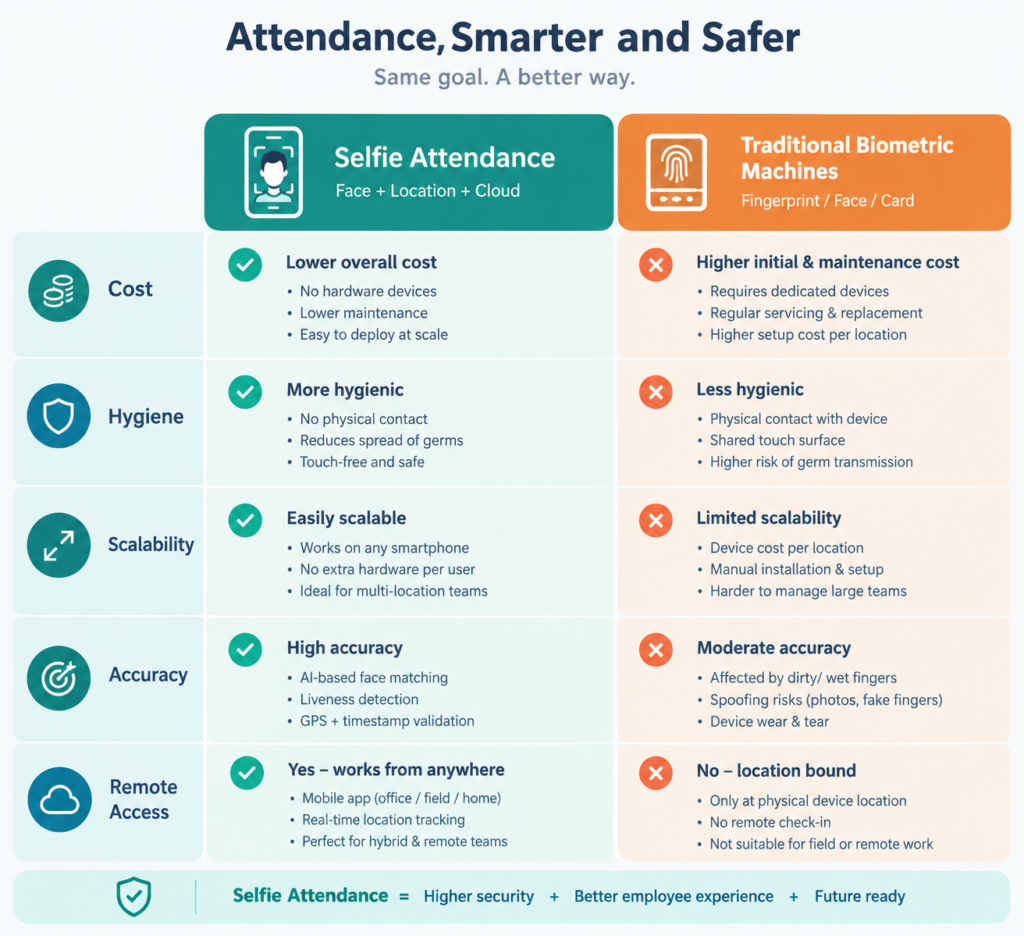
**Cost Efficiency** – Traditional fingerprint terminals involve an upfront hardware cost (₹15,000‑₹50,000 per device) plus annual maintenance. By contrast, a selfie‑GPS solution typically costs ₹0‑₹499 per employee per year, delivering 46‑55 % savings for multi‑site deployments (Buddy Punching: What It’s Really Costing Your Business).
**Hygiene & Safety** – Touch‑based scanners become vectors for pathogens. A contactless selfie eliminates that risk, a benefit that surged in relevance after the pandemic.
**Scalability & Flexibility** – A hardware terminal caps the number of users per device. Smartphone‑based attendance scales linearly with the number of employees and works equally well for on‑site staff, remote freelancers, or field technicians (Field Staff Attendance via Selfie + GPS (No Biometric)).
**Accuracy & Fraud Prevention** – Fingerprint readers can fail due to dry skin, grease or injuries. Facial recognition, especially with liveness detection, remains reliable and can even recognise masked faces with modern algorithms. Buddy‑punching is virtually eliminated because each punch carries a visual selfie and GPS proof.
**Speed & User Experience** – Median verification time for facial systems is under 0.5 seconds, compared with 1‑2 seconds for fingerprint scans. In high‑traffic environments this translates to shorter queues and higher employee satisfaction.
**Integration & Real‑Time Reporting** – Cloud‑native selfie platforms push data instantly to dashboards, enabling managers to monitor attendance across dozens of sites in real time. Traditional devices often rely on batch uploads or on‑premise servers, delaying insights.
Implementation Roadmap: From Pilot to Enterprise Roll‑Out
- Stakeholder Alignment – Secure buy‑in from HR, IT, legal and union representatives. Discuss data‑privacy policies and obtain consent for facial data collection.
- Pilot Selection – Choose a small, representative workforce (e.g., a single office or field crew). Configure a geofence around the worksite and enroll participants using the app’s multi‑angle capture wizard.
- Enrollment Process – Capture 3‑5 photos per employee under varied lighting to build a robust template. Store only the derived embeddings, not the raw images.
- Policy Definition – Set tolerance thresholds for facial match scores, define acceptable GPS radius (e.g., 50 m), and create fallback rules for failed matches (manual admin approval).
- Integration – Connect the attendance API to your payroll or HRMS. Test end‑to‑end flow: punch → data sync → payroll run.
- Training & Communication – Provide step‑by‑step guides, short video demos and a help desk channel. Emphasise the hygiene and fraud‑prevention benefits.
- Scale Up – Gradually add more sites, adjust geofences, and enable offline mode for areas with unreliable connectivity.
Real‑World ROI: Numbers That Matter
Multiple case studies report savings of 2‑8 % of payroll by eliminating buddy‑punching and reducing manual correction effort. For a mid‑size firm with a ₹2 crore payroll, that equates to ₹4‑16 lakh saved annually. Additionally, the reduction in hardware maintenance (no fingerprint scanner replacements, no power‑outage downtime) adds another ₹2‑5 lakh per year.
Field teams also benefit: a construction company reduced average punch‑in time from 45 seconds (queue at a kiosk) to under 2 seconds, allowing workers to start tasks earlier and improve overall project velocity.
Addressing Common Concerns
- Lighting & Angle Sensitivity – Modern AI models are trained on diverse datasets, handling low‑light and side‑profile shots. Providing clear on‑screen guidance (e.g., “move to brighter area”) mitigates residual issues.
- Privacy Regulations – Store only encrypted facial embeddings, not raw photos. Offer employees the ability to delete their data on request, and conduct regular privacy impact assessments.
- Device Compatibility – The solution runs on any iOS or Android device released within the last five years. For organisations that forbid personal phones, provide a low‑cost company‑issued device as a compliance option.
- Mask Wearing – Advanced systems focus on peri‑ocular features (eye region) and can authenticate with masks on, a critical capability for healthcare or manufacturing settings.
Future Trends: Beyond the Simple Selfie
Selfie attendance is the first step in a broader move toward multimodal biometric authentication. Upcoming features include:
- Edge AI Processing – Performing facial matching directly on the device reduces latency and lowers cloud‑storage exposure.
- Voice & Behavioral Biometrics – Combining voiceprint verification or typing‑rhythm analysis adds layers of security for remote workers.
- Continuous Presence Monitoring – Using periodic passive facial checks to confirm that an employee remains on‑site for the duration of a shift.
- Integration with Access Control – A single facial scan can unlock doors, log attendance, and trigger time‑based permissions, creating a unified security ecosystem.
As AI models become more efficient, we can expect even higher accuracy in challenging environments (extreme back‑lighting, partial occlusion) and lower power consumption on mobile devices.
Conclusion: A Strategic Shift Towards Trust, Hygiene, and Agility
Selfie attendance systems synthesize facial recognition, GPS verification, and cloud‑native architecture into a single, user‑friendly workflow that directly addresses the shortcomings of traditional biometric machines. They cut hardware costs, eliminate touch‑points, and provide irrefutable evidence of employee presence—critical for reducing buddy‑punching, ensuring payroll accuracy, and supporting a mobile, hybrid workforce.
For organisations looking to modernise their time‑tracking processes, the path forward is clear: start with a focused pilot, leverage existing smartphone ecosystems, and gradually expand to a enterprise‑wide solution that can integrate with payroll, leave management and access‑control platforms. The result is a future‑ready attendance strategy that scales, protects privacy, and delivers measurable ROI.
Ready to replace clunky fingerprint terminals with a simple, secure selfie? Explore the options and begin your transformation today.